Welcome to the final of my Top Toys series! To read more about why I am doing this series, please check out Part One HERE. You can also check out part two HERE and part three HERE.
I am writing these posts to help parents pick good, quality toys for their infants, toddlers and preschoolers that can be used to help support speech and language development. As I share with you my personal top picks for toys for infants, toddlers and preschoolers, I will also be sharing the areas of speech and language that these toys can help support. However, as I noted in part one, it is important to know that for these toys to help support speech and language development you, as the parent or caregiver must help to facilitate that language. What I mean is this: You can’t just give a child a shape sorter and expect him to magically know and use the names of shapes and colors! You need to sit with your child and facilitate his learning. You need to use some strategies that I have mentioned before including:
Parallel Talk, Self Talk, & Descriptions
Expansions, Extensions, and Repetitions
Commenting and Asking Questions
If you are a fellow speech pathologist and work with infants, toddlers or preschoolers, you may also find this series of posts valuable for choosing therapy materials.
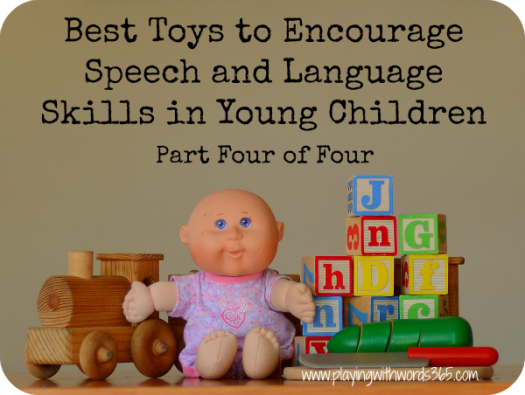
Here are my last five top picks for toys (in no particular order).
Ride on Toy/Car
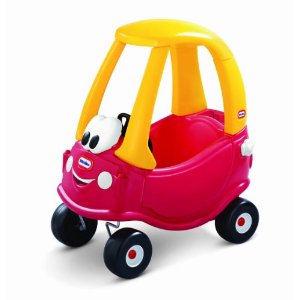 I think every child should have access to come kind of ride on car. The Little Tikes Cozy Coupe
- Basic Concepts: You can basically work on ALL prepositions like in, out, on, off, through, next to as you drive the car all over.
- Part/Whole relationships: The car is PERFECT for working on part/whole relationships! Doors, windows, bumpers, lights, roof, etc.
- Following/Giving Directions: Give the child directions on where to drive the car…down the hallway, around the corner, between the chairs…etc. Then have the child give a peer directions on where to drive the car!
- Social/pragmatic skills: Ride on toys and cars are fantastic for working on social/pragmatic skills including eye contact, topic initiation, topic maintenance, topic closure, personal space, sharing, asking and answering questions, etc. This can be a great time to work on requesting a turn, waiting for a turn, helping a friend get in or out of the car, interacting in play scripts, etc.
Inset puzzles
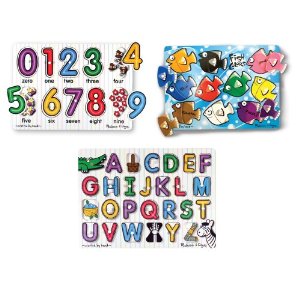 Insert puzzles, like the ones above from Melissa and Doug, are great for little learners. Not only are they great for fostering cognitive skills such as problem solving, reasoning, visual processing and spacial awareness skills, puzzles can also encourage fine motor skills and can be used to teach vocabulary and other language concepts. Let’s look at just some of the language concepts that puzzles can help teach and support:
- Vocabulary/labels: Inset puzzles tend to have items in them in certain categories, so they can be very jelpful in targeting vocabulary in specific categories. For example, farm animals, ocean animals, zoo animals, transportation, occupations/community helpers, numbers, letters, shapes, colors, etc.
- Basic Concepts: Some puzzles are specifically designed to target basic concepts like colors, however you can use puzzles to target all sorts of other concepts. For example if the child needs to learn big vs small you can teach this using a farm animal puzzle and using the different sized farm animal puzzle pieces. You can do the same for other size concepts as well as
- Verbs: You can target a variety of verbs with puzzles. You can target the verbs that are associated with the items in the puzzles: i.e. animal puzzle can target verbs like sleep, eat, walk, run, and make their different “animal sounds.”
- Part/Whole relationships: Puzzles are GREAT for part-whole relationships! Depending on the exact puzzle, you can target parts of one object or parts of many.
- Answering “wh†questions: You can ask your child an array of questions to work on her understanding of the target vocabulary. What animal goes “moo?” Which person puts out fires? Which vehicle does the police man drive? Again the specific questions will vary depending on the content in the puzzles.
- Social/pragmatic skills: Though puzzles can be a great independent activity, they can also be done in pairs or in groups to help promote social skills including eye contact, topic initiation, topic maintenance, topic closure, personal space, sharing, asking and answering questions, etc.
Magnetic letters and board
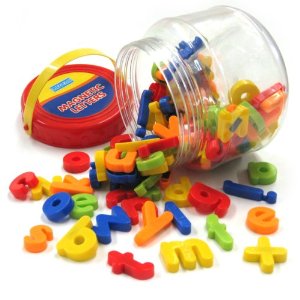 OK of all the toys I have mentioned, these probably have the least versatility in regards to language support specifically. However I have found that most kids LOVE playing with magnetic letters in one way, shape, or form. My daughter LOVES playing with hers and she really doesn’t ID letters yet at age three…but she will put the letters together and make up “words” and the more exposure to letters the more opportunities she will have to learn them in the long run…and reading promotes language development and language development promotes reading! Let’s look at just some of the language concepts that magnetic letters/numbers can help teach and support:
- Basic Concepts: You can target letter ID (obviously, right?) and colors. You can also use the magnet letters in a barrier game and work on prepositional concepts. I did this once with a preschool student who was VERY into letters and he was VERY motivated!
- Following/Giving Directions: As I mentioned above, you can use the letters in a barrier game to target prepositional concepts.
Magnadoodle
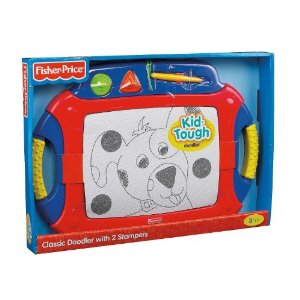 The Magna Doodle id SUCH a fun toy! I remember mine as a kid very fondly. My daughter has two: a full size one (the Kid-Tough Classic Doodler
- Vocabulary/labels: This is where you can get CREATIVE! you can draw whatever vocab you want to work on! Cars, trucks, animals, concepts, numbers, shapes…the possibilities are endless!
- Basic Concepts: You can basically work on ALL basic concepts using this tool by using simple drawings: Prepositions like in, out, on, off, through, next to; Size concepts like big, small, biggest, smallest, bigger, smaller; colors; counting skills; shapes
- Verbs: Again, the possibilities are endless here! You can target any verb that you can draw!
- Part/Whole relationships: You can draw basically ANYTHING and then work on teaching the parts of the whole.
- Following/Giving Directions: You can use the Magna Doodle to practice following directions. You can use two (or more) of them and use them in a barrier game!
- Answering “wh†questions: You can ask your child an array of questions to work on her understanding of the target vocabulary using the pictures you each draw.
- Social/pragmatic skills: You can use the magna doodles to practice many social pragmatic skills such as eye contact, topic initiation, asking and answering questions, etc.
Play-dough (you can make your own!)
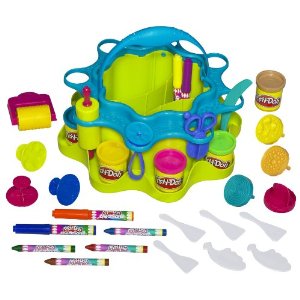 I saved one of the best for last. Play Dough is a VERY versatile product that can be used to work on SO many language concepts while also providing fine motor skill development. I personally recommend the Play-Doh Creations Caddy
- Vocabulary/labels: You can target all the different vocab related the the tools you use (scissors, pizza cutters, rollers, etc) as well as the different shapes you make or the items you make.
- Basic Concepts: You can basically work on ALL basic concepts with play dough: prepositions like in, out, on, off, through, next to; Size concepts like big, small, biggest, smallest, bigger, smaller; colors; counting skills; shapes.
- Verbs: cut, push, roll, twist, put in, take out, smash, squeeze, etc
- Part/Whole relationships: You can even target part/whole relationships when creating different items with the dough…like making a tail for a dog or eyes on a person.
- Following/Giving Directions: You can do a 3D version of a barrier game to practice following and giving directions!
- Answering “wh†questions: You can ask your child an array of questions as you sit and create things with the dough.
- Social/pragmatic skills: You can target eye contact, topic initiation, topic maintenance, topic closure, personal space, sharing, asking and answering questions, etc. as you have the children make different items out of the dough.
I hope that these series of posts have helped you choose some toys for your child, grandchild, students or clients and have helped give you some insight into how each toy can help support and promote language skills in some way.
Please check out the links below for my other 15 picks!
Best Toys for Speech & Language Development: Part One
Best Toys for Speech & Language Development: Part Two
Best Toys for Speech & Language Development: Part Three
Cheers!

Hi my name is Jami & I have a 4yr old daughter with a speech delay. I just want to say thank you for taking the time to make this list of educational toys for parents. It is difficult to choose a toy sometimes you don’t know if it is good enough or if it will work at all. Thanks again & god bless.
Hi Katie,
I can’t say how much to thank you for this website.
It help me to calm down and used the toy we had in the house to learn, Jonah is 30months old with speech delay about 18month behind in speech. I wish I now it earlier…I’m struggling to find materials and tip to communicate with him. Frustrations for both of us as I don’t understand him and he throw tantrum and I don’t know how to deal with him. I speak quite fast, may be that’s y he don’t get me. We r seeing speech therapist at the moment, but Jonah still not talking and had very own agenda.
Thank you for the very useful website. Ur education is worth the time and effort. You must have helped lots of parents who struggled like me.
Bian
I am loving your blogs, your materials and your insight! Like you, I love empowering my parents to fully participate in the therapy process because the progress is so much more! I often refer them to your blog and the information that you provide! This list of toys is just what I’ve been looking for! And I always give you credit and refer to your website.
Keep up the great work empowering parents!
Hey Katie
I just found your website and it gave me so much insite about my son and his needs. He is 28 months with speech delay and I’m a first time mom. It was overwhelming trying to figure out what I can do on my end to help him aside from his speech therapist and you put it all into perspective! I’m very grateful for the few words my son DOES say and he shows me what he wants but we still have a long way to go. I read all of the toy blogs and the intro to speech delay . I can’t thank you enough!