Therapy Thursday: I Can’t Live Without My Sand Timers!

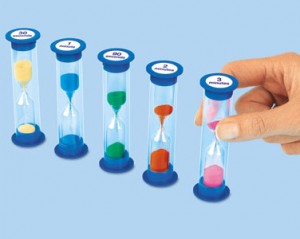
Sand Timers from lakeshore
My first year out of school, I worked with the severely handicapped population. I worked with children aged 5 to 18 with about 3/4 of my caseload being on the autism spectrum. I started researching EVERYTHING I could about working with children of this population. Hours and hours and hours. One of the things I had read about was the use of visual timers in therapy.
The first visual timer I learned about and used regularly was the Time Timer. However…there were some cons to this timer…and then it broke! Then a coworker, a Board Certified Behavior Analyst told me she preferred using sand timers…I decided to buy a few and I never looked back. In fact….it is one of the best tools I use in therapy!
Why use timers?
There are MANY reasons why you might want to start using timers in your sessions. When I first bought my timers, I thought I would only use them with my autism students, however I found that I use them with all my students for various reasons.
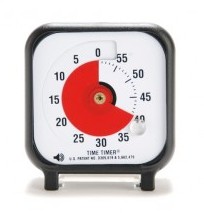
Time Timer
- Give little ones a visual representation of how much time is left in an activity or in a session. Time is not something that we can “see” and especially for those who are visual learners, time can be a very hard concept to grasp.
- Giving children a visual “cue” of how long is left in an activity or session can ease anxiety and negative behaviors in relation to the ending of an activity and transitions to the next
- Use timers to help a child know when to start or stop an activity on their own which can help a child gain independence.
- Use timers to keep yourself on task within sessions
When and How I Use Visual Timers
- With children who need instruction in short bursts, followed by short breaks (in a discrete trial sort of way), I use sand timers to show the child how long we will be working for, and how long the “break” will be for. The length of time for each activity varies by the child. Some children start out with only “working” for 30 seconds! Then we slowly build up to longer and longer work times.
- For my small groups, I will use the timers to keep myself on track. When you are working with groups of children, it can sometimes be difficult to give each child an equal amount of attention/interventions. So, I will use the timers to make sure I do this. I typically use my 2 minute timer and work with each child for 2 minutes, and then move around the room. Or, for children who have written work…I may set the timer for 5 minutes and work with one child 1:1 while the other children work on their individual work.
- Articulation Games: For articulation, I love to use my 60 or 90 second timers and have the students try to say as many words with their target sound correctly in that time frame. I will keep track and write down how many they say and if they beat their number from their previous turn, they get a couple M&Ms or jelly beans.
Which Timers to Use?
I personally use the Giant Sand Timers Set and the Classroom Sand Timer Set from Lakeshore Learning.
Want to learn more?
If you want to read more about using timers in therapy sessions, check out these articles:
Visual Timer Handy Handout from Super Super Inc.
How to Use a Visual Timer PDF by Mike Woods, MA BCaBA
Visual Timers at Autism-Tips
Use Visual Timers to Ease Transitions by Adapting Creatively
3 Responses to Therapy Thursday: I Can’t Live Without My Sand Timers!
Leave a Reply Cancel reply
Welcome!
Welcome! I'm Katie- a mama to two littles and a pediatric speech language pathologist. You'll find all kinds of goodies here about speech and language development and tips to help expand speech and language skills in children! I hope you enjoy your stay and learn a little along the way. Popular
- Top Toys & How They Can Support Speech & Language Development (Part One)
- Five Playful Ways to Work on Listening and Following Directions
- My Tricks to Teaching the /r/ Sound
- Want My 5 Tips to Help Your Toddler’s Speech and Language Development?
- The Old Lady Who Swallowed a Chick Activities
- Top Toys & How They Can Support Speech & Language Development (Part Two)
- Your Child’s Speech & Language Development: Birth to 5
- Your Child’s Speech & Language: Birth to 6 Months
- Articulation Development: What’s normal? {& What Isn’t}
- Barrier Games: Great for Language Enrichment
Topics
- Apraxia and Dysarthria (3)
- Articulation & Phonology (aka Speech Sounds) (15)
- Better Speech and Hearing Month (1)
- Bilingualism (1)
- Blogging (22)
- Book Reviews (2)
- Books and Literacy Activities (27)
- Children's Songs and Fingerplays (2)
- Collaborative Posts (1)
- Continuing Education & Certifications (1)
- Crafts for Kids (13)
- Current Events (1)
- Developmental Milestones (18)
- Family Life (30)
- Fine Motor Activities (11)
- Fluency/Stuttering (1)
- Freebie Friday (16)
- Games (17)
- Giveaways (11)
- Guest Post (21)
- How to Help Your Child Talk (18)
- Involving Parents in Therapy (1)
- Juvenile Arthritis (14)
- Language Enrichment Activities for Parents (58)
- Listening & Following Directions (1)
- Making Materials (2)
- Money Saving Ideas (1)
- Movement (4)
- Pacifiers and Bottles (1)
- Parenting (8)
- Phonological Awareness (1)
- Picky Eaters (1)
- Pinterest (1)
- Planning Therapy (1)
- Play (16)
- Playful Ways to…..Series (2)
- Product Reviews (5)
- Sign Language and Baby Sign (19)
- SLP Forms, Charts, and Data Sheets (4)
- Social Media (2)
- Sound Elicitation Techniques (1)
- Special Needs Topics (2)
- Speech & Language 101 (36)
- Surveys (8)
- Technology and Speech & Language (1)
- The ABC's of Early Speech & Language Development (6)
- Therapy Ideas and Activities (73)
- Therapy Materials and Product Recomendations (24)
- Toys and Language Learning (8)
- TpT Product Reviews (1)
- Virtual Book Club 2012-2013 (6)
- What is an SLP (2)
- WHat You Can Expect From Speech Therapy {A Guide for Parents} (3)
- Where to get FREE Speech Materials (2)
- Why Does My Child____? {And is it Normal?} (4)
Activities by Theme
- "Wh" Question Activities (1)
- 4th of July (1)
- Apple Activities (1)
- Balloon Activities (1)
- Barrier Games (3)
- Basic Concept Activities (1)
- Basketball Activities (1)
- Bat Activities (1)
- Bean Bag Activities (1)
- BINGO (1)
- Bowling Activities (1)
- Bunny Activities (1)
- Chinese New Year (1)
- Chinese New Year Activities (2)
- Christmas Activities (2)
- Clothespin Wheels (2)
- Cooking Activities (1)
- Describing Skills Activities (2)
- Easter Activities (4)
- Fall Activities (12)
- Figurative Language (1)
- Following Directions (1)
- Gross Motor Activities (1)
- Halloween Activities (8)
- Hopscotch Activities (1)
- Insect Activities (2)
- Jeopardy Activities (1)
- Kids Charts (1)
- Leaves Activities (1)
- Letter and Number Activities (3)
- Multiple Meanings (1)
- My Book About Me By Dr. Seuss Activities (1)
- Ocean Life Activities (1)
- Octopus Activities (1)
- Old Lady Who Swallowed A Chick Activities (2)
- Old Lady Who Swallowed a Clover Activities (3)
- Outdoor Play (1)
- Outside Activities (1)
- Owl Activities (1)
- Penguin Activities (1)
- Preposition Activities (2)
- Pumpkin Activities (2)
- Pumpkins Activities (1)
- Reindeer Activities (1)
- Ring Toss Activities (1)
- Science Experiments (1)
- Sign Language Activities (3)
- Snowflake Activities (1)
- Snowman Activities (1)
- Songs and Fingerplays (1)
- Spider Activities (2)
- St. Patrick's Day Activities (6)
- Story Telling Activities (1)
- Superhero Activities (1)
- Teaching Name Activities (1)
- the annoying /r/ (1)
- The Gruffalo Activities (2)
- The Night before St. Patrick's Day Activities (1)
- The Rainbow Fish Activities (1)
- Top Cat Activities (1)
- Travel Activities (1)
- Valentine's Day Activities (2)
- Water Play (1)
- Winter Activities (3)
- Yoga (1)
Don’t want to miss anything? Have posts delivered via email!
Still Looking for Something? Check out the archives
Custom SearchBooks I Recommend
Looking for Something?


I agree, time management is such a struggle for many of the children we work with. I personally use an online stopwatch that not only provides a variety of visuals (candle, sand-timer, swimmers etc.) but a sound that alerts everyone when the time has elapsed. Read more about it at: http://www.letstalkspeechlanguage.com/2012/06/resource-of-week.html
Ms.Sohan recently posted..Summer Update
I am also working with a caseload with the majority of kids on the spectrum. I am also trying to RESEARCH, RESEARCH, RESEARCH!!! Any other AU specific suggestions?
There is an online resource called Timerland, http://www.timerland.net , so far there is two timers, a farm timer and a planetary timer. Both are fantastic