What is figurative language? Who may have a hard time understanding it and why is it such an important thing for our kids to understand? Finally, what kinds of activities can promote skills in this area of language? Ms. Sohan from Let’s Talk Speech and Language brings us an EXCELLENT post today which will answer all these questions and more! This post made me miss the middle schoolers I used to work with (well…a little any way 😉 ) ~Katie
Students are expected to comprehend different types of figurative expressions as they advance through middle school to high school. Research shows, and I’m sure many school based SLP’s will agree, youngsters with language impairments frequently have difficulty with allegorical language. Below is great example of a previous exchange where a figurative expression was misinterpreted:
In the above example, this student took the literal interpretation of what I stated (as well as peers) and ended up being (playfully) teased by his classmates.
Not only does figurative language add richness to spoken and written language, it’s also frequently used in academic world communication. Research conducted by Lazar and colleagues (1989) found that the frequency in which teachers used idioms in the classroom began at 4.65% in kindergarten and increased to 20.3% by 8th grade.
Language impaired students are often unable to extract meaning from figurative expressions. Â As a result, these students operate with a disadvantage when compared to their typically developing peers. Poor decoding skills further hamper their ability to gain meaning from figurative language, as clues to decipher figurative meanings are provided within the context of text.
Simply put, language impaired students are not just missing out on academic content, they are also missing out on casual classroom banter from their instructors! This is not only unfortunate but unfair.
To aid in their comprehension of figurative language I implement the use of illustrations. Since many of my students are poor decoders (as with many language impaired students), the use of visuals assists them, as it depicts the figurative expressions in a more salient manner. I like to use comics.

When searching for comics I use sites like GoComics.com, where you can sign up for their mailing list and receive daily emails that include embedded comics. Users are also able to ‘favorite’ or ‘collect’ (mini-series or themed group of comics) images of interest. I personally find comics from the series “Bound and Gagged,†“The Argyle Sweater†and “Reality Check†to be useful as their content is appropriate and able to be grasped by most of my students. I keep track of my favorite comics on my Pinterest board.
Comics to my liking are first printed and pasted onto index cards. Â I personally like to laminate them, as this prevents them from getting torn, stained, and wrinkled.
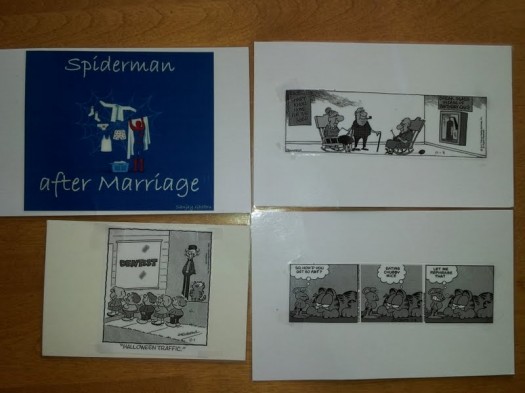
I usually start off a session by presenting my group with a preselected comic. I pass it around the room and ask students if they find any humor in it. Usually they respond with: “No, it’s not funny.†At that point I politely inform them that they probably don’t find it funny because they do not understand it. If no one seems to be getting it, I provide prompts to assist in the process, asking questions like “What’s going on in this comic?â€, “What do you see?â€, etc.
The comic below depicts the idiom: “Bring home the bacon.â€
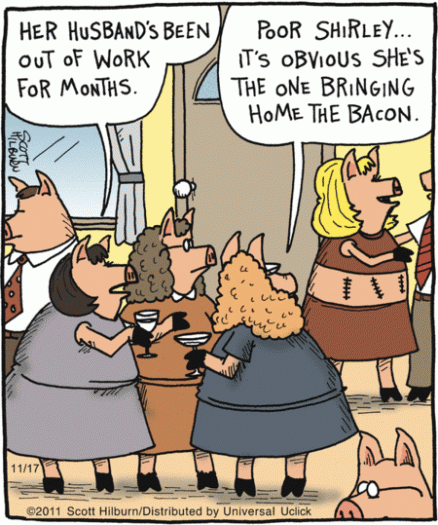
After presenting the image to my students I ask them to describe what they see. Prior to discussing the figurative phrase, it is important to have all students on the same page regarding what is presented in the cartoon. Many students mistook the stitches on Shirley’s stomach to be stretch marks, this misinterpretation would have greatly affected their ability to grasp the appropriate meaning of this idiom.
To assist with organizing their thoughts, a graphic organizer is provided to the students. After discussing the comic, they are expected to fill out the first three sections of the organizer independently (i.e. “What I Seeâ€, “What I Knowâ€, & “Literal Meaningâ€). Each student will share their responses aloud. Afterwards, as a class we discuss the figurative message of the comic. Probing questions like, “What is the cartoon trying to say?†are frequently asked. After students share their figurative interpretation of the illustration, I elaborate on their explanations, filling in any missing pieces of information.
Lastly, to make the figurative phrase more meaningful, I use it in a context that is familiar to them. Only in making our lessons meaningful can we help our students see the relation of their academic coursework to their lives and future goals.
What techniques/lessons do you use to target/cultivate abstract thinking?
Resources:
LAZAR, R. T., WARR-LEEPER, G. A., NICHOLSON, C. B., & JOHNSON, S. (1989). Elementary school teachers’ use of multiple meaning expressions. Language, Speech, and Hearing Services in Schools, 20, 420-430.
Ms.Sohan is a Middle School Speech-Language Pathologist from New York. She is the author of the blog Let’s Talk Speech and Language where she posts about behavior management, free apps, therapy techniques, and more.

Leave a Reply