Welcome! As an SLP I am asked all the time about articulation development. Should my 4 year old be saying his /r/ yet? Is it normal for my 3 year old to say “lellow?” Today I am going to talk all about your child’s articulation development and go over what is normal and what isn’t.
When do children begin to develop their articulation and phonological (aka speech) skills?
Believe it or not, children begin to develop these skills starting at BIRTH! I know I know, babies are not born talking…but they are born listening and listening is the first step in learning how to produce speech sounds, which in turn will turn into meaningful words, phrases and sentences! If I remember correctly (I’ll go find the study and link it back here) children learn the sounds of their native language by NINE MONTHS OF AGE! This doesn’t mean they are producing the sounds…it means they have already learned the sounds receptively and are starting to get them all organized in their amazing tiny little brains so that when their motor skills are developed enough, they can begin producing them. Honestly, it is pretty fascinating what BABIES are taking in those first few months of life when seem like boring little sloths 😉
What is “normal” articulation development? When should my child have mastered the production of all the speech sounds?
There have been many studies on this and as a result, there are actually several different sets of “speech sound acquisition norms” (go ahead and Google….you will find MANY different charts out there!) Some of the most well known studies include Sander (1972), Prather, Hedrick, & Kern (1975), Templin (1957), Smit et al. (1990) and Goldman-Fristoe Test of Articulation (2000). Each of the studies had slightly different results, which really just tells us that there can be a pretty wide range of “normal” in regards to when your child will master the production of the different sounds, and that we don’t really know for sure when sounds should be 100% mastered. That said, these sets of norms can be helpful to decide if a child will need speech therapy to correct a sound.
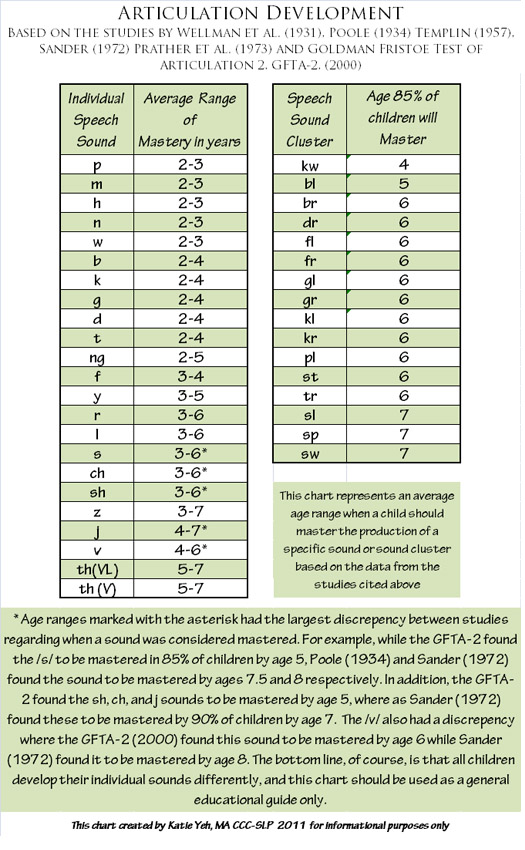
Here is a chart I created based on the following six studies on speech sound acquisition:Â Wellman et al. (1931), Poole (1934) Templin (1957), Sander (1972) Prather et al. (1973) and Goldman Fristoe Test of Articulation 2, GFTA-2, (2000).
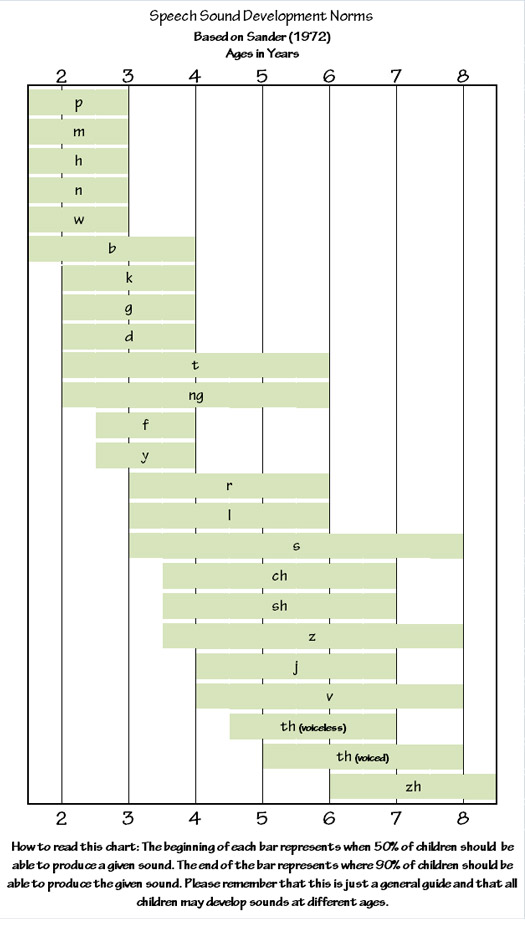
 Here is the most widely used set of norms used by SLP’s in the US, based on the research paper by Sander 1972.
 One thing we do know, is that there is not a strict developmental hierarchy, per say, when it comes to the individual sounds. What I mean is…that all kids don’t necessarily earn the /p/ and then the /m/ and then the /h/. The order in which a child can learn to produce the different sounds in English can vary. However, some researchers including Shriberg (1993), did find that there is somewhat of a developmental sequence to when children master speech sound productions. He referred to them as the Early 8, Middle 8 and Late 8 (EML).
Early 8- m, b, y, n, w, d, p, h
Middle 8- t, k. g, ng, f, v, ch, j
Late 8- sh, s, z, l, r, th (voiced and voiceless)
As you can see, if your child is say… two or three years old.. we wouldn’t expect him to be able to accurately produce the /r/ sound, for example. Usually, children produce the /w/ for the /r/ as in “wabbit” for rabbit or “gween” for green when they are toddlers and preschoolers. For an /r/ at the end of the word, a young child may simply leave the sound off like “ca” for car or he may attempt to produce it but the the sound is a little distorted.
These types of age appropriate errors are referred to as developmental errors. This just means, they are normal, age appropriate errors and they do not require speech therapy. There is an exception to this rule, however, if the child’s errors are actually a result of a phonological delay rather than an articulation delay. I’ll be explaining this in my next post.
How can I tell if my child is developing his/her articulation skills appropriately?
Well, first I would encourage you to look at the charts on this post and see if your child is using most or all of the sounds he/she should be for his age. Also, here is a good general rule of thumb for how intelligible (i.e. how much of his/her speech you understand) your child should be at the following ages. It is the child’s age in years divided by 4 (Reference: Coplan, J., & Gleason, J. R. (1988). Unclear speech: Recognition and significance of unintelligible speech in preschool children. Pediatrics, 82, 447–452.)
2 years old = 2/4 or 50%
3 years old = 3/4 or 75%
4 years old = 4/4 or 100%
Another thing to remember: A child, as he/she is learning to speak, will have errors in his/her speech. We expect it, and most kids will go on to learn how to accurately produce all the sounds. However, if a child has MANY ERRORS and cannot be understood, especially after the third birthday…it may be a good idea to have your child seen by an SLP.
However if you have ANY concerns at all….I encourage you to have your child screened by a speech-language pathologist. Check out the information HERE discussing when you may want to refer to an SLP and check out the info HERE on how to find an SLP.
Next up…speech development isn’t just about articulation. It is also about phonology, or the patterns in which our children learn how to use speech. You can read all about phonology HERE.

This is such great information!! Thanks again!
Michelle you are so welcome! 🙂
I would like a copy (pdf or doc) of your articulation and phonological processing charts. Would you please send them to me?
Shelly there should be links to the PDFs in my Freebie section! 😀
Thanks!!
Thank you!! Great information to save and reference as I’m working with my kids.
You are welcome Elaine 🙂
My daughter is 7 about the be 8 we live in the south but she sounds like she is from the Jersey Shore do you like that is normal or should it be looked at
What a lot of useful information! I shared this post on my Facebook page as part of the KBN shout out. Such a great resource you are to parents!
Thanks so much Anna!
So very helpful! Already shared some info from your site but there is so many helpful posts…I’m back for more! Thanks!
Laura M recently posted..Spoiler Alert! Father’s Day Gifts (A Story of Trial and Error)
Thanks Laura!
Very nicely stated! I normally use the “commonly” known bar-chart, which I feel needs more explaining. I like your summary chart that lists the ages.
Katie, thank you so much for putting this article together. It’s so helpful to parents, like me, who don’t know whether their worries about their kids’ speech are simply a symptom of helicopter parenting! I linked to your article last night on a post on my recent relief on finding out that my 7-year-olds don’t need to return to speech therapy to work on the their /r/s. I’m definitely going to be coming back to check out the rest of your site. If you ever feel like guest posting on the multiples site I write for, we’d love to have you! Speech issues are so common among twins, triplets and more and we parents often feel out of our depth in seeking help.
Sadia recently posted..Speech Re-Evaluation: All Is Well!
Hi Sadia, I love hearing that my information is helping others! Thanks so much for stopping by and letting me know you linked up, I’ll be sure to head over and check out your blog! 🙂
Thank you for sharing this. I was wondering about a child learning another language. Right now we live overseas and my daughter (will be 5 in January) is in national school where she is learning arabic. Will her English pronunciation have any delays or differences? What should I expect? Thanks again and I will share with friends.
Could you please explain the /ng/ sound? Is it an initial sound or just an ending sound as in song?
Thank you!
Yes, it is the sound at the end of the word song, sing, etc. In American English it is not found in the initial position of words.
This article is quite reassuring. My son just turned 22 months on March 27th, and his old daycare teacher use to try and tell me how I should keep an eye out on his speech because he doesn’t repeat words exactly how they’re suppose to be pronounced. She started telling me this when he about 18 months old. He says PLENTY of words, but of course he’s missing some letters sometimes. For instance, his version of “truck” is “kuck.” She really got all concerned because for the word “stop” he literally says it backwards…”pots.” It’s quite hilarious because he does the hand motion and stomps his foot down and says “POTS!” Because she said it more than once, I started to let worry set in which is how I ended up on your blog today. But looking at the chart you provided I feel more than reassured. He’s got the “Early 8’s” down I believe! And maybe one or so of the “Middle 8’s.” Thanks so much for sharing this information!
Hi Katie,
I am a SLP in Salt Lake City and love your website and materials! I especially enjoyed using the activities with “There Was an Old Lady Who Swallowed a Clover”. My students loved them! Can’t Wait to use your Easter ideas with the “…Swallowed a Chick” book. THANK YOU so much for sharing them!
Merrilee
The EarlyMiddleLate8Chart has a mistake (typo) in it — where it says /r/ in the Early 8, that should be /n/.
Oh my goodness! You are correct! Thank you! I’ll fix that ASAP. Thanks for letting me know Laura!
my 4 year old son speaks unclear .i can managed to hear one word in his sentence as he still speaks gibbrish at the age of 4 years and 2months
Hi I have a few concerns about my grandson age 3.6 for example plip for flip a few others as well
My son is 8 has a hard time saying his r’s the speech person at the school says he he can’t even grasp the idea to make his “r” sounds.. She said he is not developed enough to get it and that they wouldn’t make any process. If she were to work with him. She wanted to check him next year! I do not understand this….. Is this not her job.. Is she not there to show him how to make those sounds?!?!? He is 8 for god sake!! I am so lost.. She said she would work with him until Oct. but I don’t have any confidence in her if she doesn’t understand her role in her job
Ms. Katie
Thanks for your article. I just finished reading it and found it very helpful. I have a son who will be 6 in October. Where we live he had to be 5 before September 1st to be in kinder so sadly he missed it. He now is kinder although he reads very proficiently & also does math and spelling fairly well. I notice that he pronounces “th” instead of “s” and I am really freaking out about it. The doctor says he’ll be ok but I worry. I don’t want to make him feel bad and need advise on what to do.
I will be so grateful on any info you are so kind to give me.
My daughter will be. 2 november 27 she is reapeting my name over and over like for example mama mama mama mama and i say whst and she keeps going also when i tell her stop she kust keeps going and doesnt even aknolowage me goes right into the street im concerened are these normal for a 22 month old also a lot of fits when we transition to new things like right when she wakes up from nap full blown fit or going from outside to inside full blown fit. Please help. Im concerned
Thank you so much for this article I have a child in speech therapy and this has been very helpful for me to understand and help him better. He’s 3 and my oldest is 4 and doesn’t have a speech problem
Thank you this is an exceptionally helpful site!
Hi I found your charts very useful but am still concerned about my granddaughters speech she has a wide vocab but still uses very baby like pronunciation could it be linked to emotional instability as she has very strong desperation anxiety also
My grandson has been receiving speech therapy for about 4 months. He is 5 1/4 years old. They have been working on “s” & “z” since Thanksgiving. Progress reports simply say “good job”. Therapist said his troubles were easy to fix & should take 6 months of therapy. He was supposed to move on to “r” but is now still on “s” & “z”. Therapy company wants his to go to OT now too. Why??????? He can say the “s” & “z” sounds correctly when prompted but does not do so in normal, conversational speech.
was looking to educate myself more to try and learn more about how to help one of my students, and lookie where i landed! beautiful page, katie — thank you for such clear and knowledgeable advice!
I love that you found me friend!!! 🙂
Hi!
How can I encourage my 3 year old to say his “i” sounds? His “i” sounds are spoken with a W or Y sound.
Thank you! My son is 34 months and has been receiving birth to three services for speech since he turned 2. He has made a lot of progresss but a lot of what he says is unintelligible. He is going to be attending preschool for the upcoming school year at age 3 due to his speech delay. They tested him using Goldman Fristoe articulation 2 test and he got 67% and it stated he was speaking at rate of younger than 2 year old level. Should I be scared too death?!?!?! Final consonant deletion, articulation errors, and has hard time with long words
Have you had any experience working with SMS – Smith Magenis Syndrome children and their speech difficulties?
Hi Mary, no I have not personally.
This is so helpful!
Maybe you an answer a question. My 3 year old is seeing SLP for some help with articulation. She used a really really long word that was very difficult to pronounce to describe something he was doing with his speech and articulation or pronounciation – not too sure what it was or what the word is but know it starts with a D. Any idea what it could be and if so, what it is?
Thanks!
Hi Katie: My grandson Leo turned 5 last week. He has problems with articulation. Difficult to always understand what he’s trying to say. He’ll also talk backwards. Instead of saying, how do you do that, he say that, you do this? He is also being treated for fine motor skill problems. Perhaps holding a crayon or pencil is a problem. He is addicted to video games on his iPad and every once in a while will sneak a pacifier. Are we talking maturity issues.? Is he developmental disabled. He’s behind in his class with attention and focus as well as articulation. Leo is a fraternal twin and his sister has not demonstrated any of those issues. Her articulation is much clearer. Concerned Grandma
I’m becoming a speech pathologist or trying to. Wondering if I can ask you a question related to articulation and the phonological processes.
Hi there! My son is almost two (his birthday is this weekend!) and he really doesn’t say a lot of clear words. He mainly makes “uhâ€, “oh†and “ah†sounds. He tries to copy words and phrases we say, which is fun! He just doesn’t seem to be able to articulate well. I’m not really worried, but a lot of people around me comment on how he doesn’t talk and another girl his age talks very well. Would you say he’s on the right track or a little behind? Thanks!