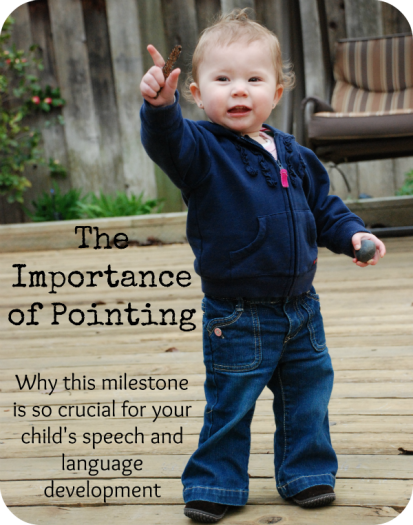
 I feel like Everett, with the exception of walking, has hit every developmental milestone earlier than his older sister. He sat up, crawled and spoke his first word earlier than she did. Yeah yeah yeah, I know you aren’t supposed to compare your children but I’m sorry: I am human and I will compare them sometimes. Plus, as a speech pathologist AND mommy, I have always been fascinated with development in general, so I find it interesting how my two children have developed a little differently.
At a year old, it was like a switch was turned on and Ev started pointing and “talking” about EVERYTHING. This kid is obsessed at pointing at things and “discussing” them with us. You know, very intelectual conversation. For example-“babababaguhdadadadada” or “guhguhguhguhbababababamamamamama”.
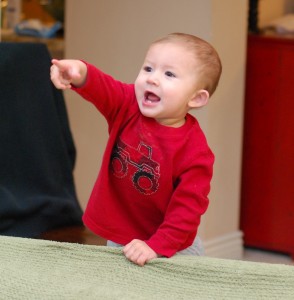 Yes, he is a pointing and babbling machine these days. Which, is very different from his older sister at the same age. She never pointed this much!
When I am doing an assessment on a child, one of the questions I always ask is does the child point to objects of interest. I have had many a parents wonder why this is so important. As an SLP I have always known why it is so important, but now that I have children I know firsthand how important it is.
Let’s look at what happens when our infant or toddler points to something. Let’s see the various things that their pointing can make US do…
It makes us look at what they are pointing at.
When your toddler points at something, generally the first thing you do is look at what they are are pointing at. This pointing is your child initiating joint attention. That is, your child wants you to attend to the same item of interest as they are attending to. Joint attention is a very important communication and social skill.
 “The frequency with which infants engage in joint attention is related to their language acquisition, even when variance associated with general cognition is controlled (e.g., Morales et al., 2000; Mundy et al., 2007). Joint attention is also associated with the depth of information processing in infants (Striano, Chen, Cleveland, & Bradshaw, 2006), as well as with individual differences in childhood measures of IQ, self-regulation, and social competence (Mundy et al., 2007).” (Mundy & Newell, 2007). Children who do not initiate joint attention can have great difficulty learning language, participating in symbolic play, understanding social cues, and learning by observing/watching others.
(Click HERE to read the whole article Attention, Joint Attention, and
Social Cognition by Peter Mundy and Lisa Newell that I quoted above.)
It makes us label what they are pointing at.
When your child points to something, one of the first things you may find your self doing is simply labeling the item of interest. For example, let’s say your son points to an airplane in the sky… you probably will say something like “Look! It’s an Airplane!” This is how your child will learn the names of many objects, by pointing at them and showing you.
It makes us describe what they are pointing at.
After you have labeled the airplane, you may find yourself describing it. You may find yourself saying something like “Yes, that’s an airplane. It is flying high in the sky. The pilot is flying the plane!” Now your child is learning more words like flying, high, sky, and pilot in addition to the label airplane. So far, your child has been exposed to five new words, simply by pointing out an object to you!
It makes us ask them questions about what they are pointing at.
 In addition to labeling and describing, you may also find yourself asking your child questions about the object that you know they can’t actually answer yet. For example, you may say something like “Do you hear the sound the airplane is making? It’s going rrrrrrrrrrrr!” Or maybe when it starts to get farther away “Where is the airplane Johnny? Where did it go?” Asking your child these questions, even though they can’t answer them yet, is providing your child with a model for asking questions. Children learn from what they hear and see.
When should we expect a child to be pointing?
Like any developmental skill, there is a range of “typical”. When I was doing research for this post, there was a pretty large range for pointing: most sites said around 12 months with a range of 9-15 months, with one site even saying 18 months. However, it is important to note that this range includes all forms of gestures, and not just pointing. This includes gesturing towards items, clapping, waving, or using other gestural communication. A gesture is defined by the use of a bodily action (hands, face, head or other parts) that is used to convey some sort of message, either without speech or paired with speech. So if your child is 12 months and is not pointing but he is using other forms of gesturing to communicate, hold tight because it probably going to come soon! That said, if your child is not pointing to share with you items of interest by 15 months, I would consult your pediatrician just in case.
What can I do to help teach my infant/toddler to point?
- First of all, model, model model. I do wonder if many Ev is pointing so much because he has his older sister to model. Modeling pointing is very important.Walk around your home and point out and label objects. Do the same at the park, the grocery store, in the car.
- Play pointing games with your toddler. Point to your body parts and his body parts while labeling.
- Blow bubbles for your child, and practice popping them with your fingers…many children will naturally use their first finger to try to pop them. Model both pointing at the bubbles and popping them. Make sure you are using language the whole time.
- When your child does start to point, the best thing to do is get REALLY excited about whatever it is he is pointing to! Give lots of attention about the pointing, which will provide positive reinforcement resulting in more pointing.
- Some children with delays, like those with autism, may need more direct teaching on how to point, like hand-over-hand instruction with immediate reinforcement. This type of instruction needs to be tailored to the specific child by a professional (and then taught to the parents) such as a speech-language pathologist or a board certified behavior analyst.
Most children will start pointing to objects on their own. Modeling, and modeling often, is the best course of action in the beginning. If your child is not pointing by 15 months, or is not using any gestures by 12 months, you should bring it up with your pediatrician just to be safe.

This is fascinating and in retrospect, I had some very avid pointers and so far, some pretty good talkers.
Amanda, isn’t it fascinating?? I just love this stuff!
I love reading the developmental reasons (in easy to read terms) behind things our kids do. Thanks for sharing!
Also, I responded to your comment, but I wanted to share a couple tong/tweezer links here for you in case you didn’t go back to check my responses. We’re going to buy some in February because I have already used up my homeschooling funds for January 🙂
http://www.amazon.com/Learning-Resources-Easy-Tweezers-LER1963/dp/B00361NV88/ref=sr_1_1?ie=UTF8&qid=1327522414&sr=8-1
http://www.amazon.com/Learning-Resources-Gator-Grabber-Tweezers/dp/B006RQ8TE0/ref=sr_1_2?ie=UTF8&qid=1327522414&sr=8-2
OOhhhh Sieraa THANK YOU for the links to the tongs! YAY! You rock! And I’m glad you liked the post today! 😀
Yes, yes, and MORE yes! Pointing is so important and so easily over looked by so many people!! 🙂 It’s one of the first questions out of my mouth when anyone brings up a “late talker.”! Thanks for a great post.
Thank you Becca!! I agree, it is overlooked ALL the time! So glad you stopped by, I love your blog!
Hello! I just came across your blog (through pinterest probably) and it is so very helpful. My 3 year old is having some minor issues with speech, most people still can’t understand him (I can, and some other moms can, but not my husband.) Our insurance doesn’t cover speech therapy, it costs a gazillion dollars out of pocket here in NYC, and he’s not delayed enough to qualify for city services. So, in short, I’m trying my best to figure out ways to help him. He seems to have a good vocabulary, but just doesn’t articulate well at all. And stutters a bit; lots of “du..du..du..” in between words.
Anyway! He was never a pointer! Sometimes he does use gestures (his whole hand) to show something, but not often.
Thank you for your wonderful site. It’s an answer to prayers. I’m going to spend my quiet time searching it and learning from it.
Hi Kiasa! Welcome! I’m sorry to hear your little guy is struggling and isn’t qualifying for therapy. At Three his speech should be understood by most people. I assume you had him assessed through your local school district?
Interesting that he was not a pointer! My son is definitely more of a pointer than my daughter was. He is a huge gestural communicator!
Hope you find some information that is helpful here for you! Good luck!
Great post! I shared it on my Facebook page!
Thanks Kristin! 🙂
So true! The littles do need to point- sometimes the fingers do the walking so we can start the talking! 🙂 I work in an ECSE class 2 days a week and K-5 building 3 days a week. Pointing is an important skill to have at any age! Great article!
Shelly I LOVE it “Fingers do the walking so we can do the talking.” I haven’t heard that one before! LOVE LOVE LOVE!!! 😀
Hello! I just came across your blog through pinterest 🙂 Thank you for the great info! My son is 16 months old and severely Hard of Hearing. He’s had his hearing aides (full-time) for just 4 months so he is delayed in a few areas. And one of them is pointing. Although if we ask him “where is your dog?” or other things he does look for & at for them 🙂 So in a sense he is “pointing” Anyway, thank you for sharing your experience & knowledge. I will be perusing a bunch of your previous posts!
Erica WELCOME! 🙂 I am so happy to hear your little guy has his aides…you will be amazed at what he will start doing/saying as his ears continue to be accustomed to them. What an exciting time. Let me know if there is anything you need!
Hi there, my son is 18 mos and points at everything! He also talks with his mouth closed most of the time. He says dada and some other babble, but usually just saying sentences with his mouth closed. He responds to our requests and knows what were talking about, but a little part of me is concerned. Have you ever had any experiences with closed mouth talkers?
Lindsay, I do know some closed mouth talkers. Does he use a pacifier by chance?
No, we took the paci away at 10 months.. I think I’ve heard him saying dog and bye bye along with dada.
My son is 18 months and doesn’t point with his index finger at all. He sometimes points at something in a book we’re reading, but always uses his thumb. I really haven’t been very concerned about his development up until I read that not pointing could mean there are developmental issues. He has about 10 words, takes an interest in other kids, maintains eye contact, and seems to try to get us to share in his interests (e.g. sitting books in our laps, then looking up at us in a plea to have us read it to him). I read the article you shared, and it seems to me maybe he responds to joint attention, but doesn’t often initiate it. He’s pretty content to play solo a lot of the time. I’m definitely going to be bringing this up with his pediatrician when we go later this month, but should I also be calling for an early intervention evaluation?
I’m in the same boat now. Exactly. I’m just seeing the article. Not sure how I’d see your response but can you share what has happened since to your little one?
Hi Katie,
This is a great article. Thanks for posting. My son turned 1 year old a week ago on 08/16/13. He has clapped a few times but doesn’t wave yet. However, he started pointing at 11 months very well. He points at everything he wants, looks at my eyes and then looks at the object he is pointing. If it is something that he wants and I don’t grab it for him he goes “uh-uh” almost saying, hurry mom, get me that.
He has reached all of his milestones except for waving. He is very social, loves playing with other kids, he responds to his name (most of the time except when he is busy), is very affectionate, walks great, feeds himself food, he can drink from a straw cup, BUT he is not waving and he is now 12 months 1 week.
Should I be concerned? Is he behind developmentally?
Thanks so much!!!!!!!!!
Hi there this has been one of the most encouraging things I’ve read. I have an almost 14 month old ( born at 35 weeks) that does not wave or point. He claps and high fives will also pass things to me if I ask but I’m concerned about developmental delays and autism. I’m doing allot of repetitive showing and tonight tried the bubbles in the bath. He loves popping them but still won’t point.
Some other quick observations:
Doesn’t walk but cruises on things and will walk the length of house if pushing a chair.
Only says 3 words mumma and Dadda and yum constantly when eating.
Says Ba Ba allot so I keep finishing it with ball and bottle and book.
He does allot of experimental play not allot of imaginary. Ie he loves opening and closing doors, draws, boxes, pushing buttons and turning tv on and off. Playing with books and instruments. Not much interest in soft toys, stacking blocks or puzzles.
Prefers being outside in the sandpit or on a swing or crawling in the garden.
Has always been busy , full of energy splashing in the bath and at the pool and crawling very fast.
Eye contact is just ok and will respond to his name 7/10 times. Enjoys cuddles but doesn’t give kisses or hugs. Very clingy and loves his dad. Screams when goes out of site.
Sleeps 13 hrs at night and still has too naps
He seems like such a baby still compared to my MG babies who are far more engaged in play, talking and walking.
Are boys slower? Are premies slower? Should I get him assessed?
Hi Emma,
Can’t really answer your question but just want to let you know that my bun sounds exactly the same. He’s super, super busy. Non stop and hard to cuddle because he always wants to move. He waves and hi fives but doesn’t clap or point. The best I can get I’d pointing at pictures in books. He’s walking now (13 months) but his speech is slower. Only babbles ba ba, no words. He pushed chairs etc around the house for ages. Apparently a good amount of time a baby should creep and crawl I’d at least five months before walking so I wouldn’t worry about him not walking yet. My boy is very independent and will spend most of the day opening and closing things, pushing stuff around etc but his play has become more cognitive lately but that doesn’t bother me. His cousins played the same way. Health nurse thinks he’s just focusing on his physical development. I had thought about autism but more and more I don’t think that is the case, although I do suspect language development delay. Be interested in hearing how you’re getting on with your Lad as I haven’t come across any other babies who behave like mine very much. Good luck with him!
Hi Emma,
Now that almost another 9 months have passed since your initial comment about your 14 month old (at the time), I’d love to know how he’s doing now at almost 2 years? The description you’ve written for him sounds exactly, to the tee, like my son who’s 11.5 mos. My son does not have any gestures, other than lifting hands up to reach for us when he wants to be picked up, he isn’t walking yet (is cruising) and responds to his name almost exactly the same percentage, I’d say: 7 out of 10, sometimes worse when very engrossed in playing. Worst response is to me – he’s better with others! It’s like he still sees me as an extension of himself or something (?) Very, very busy guy – crawling fast everywhere and exploring constantly. He doesn’t have 3 meaningful words yet, like your boy had, but he still has a few months to go and does babble a lot and has at least 8-9 consonant sounds. I have been QUITE concerned with the fact that he may not reach the gestures milestone, particularly pointing, by his 12 month ped’s appointment (coupled with the not 100% perfect name response) knowing how significant that marker is. I guess I’m just looking for experience of what I can possibly expect? Did you get your son evaluated? Did he start to gesture soon after this post? Wondering whether you got him into EI or any kind of speech therapy for this issue, or if he was diagnosed with any delay? I’m going to put our son on the waiting list to be evaluated next week as a first step, but meanwhile I would love to hear about your experience, since your description rang so true to what we’re experiencing. You can email me at lizw97 @ yahoo.com (no spaces in my email – I just put them in to try to avoid being phished or spammed by bots! Thanks sooo much – I have tremendous anxiety about this and talking to others who are in/have been in same boat is so helpful!
Hi,
U have written the post in 2014. Its been two years now, so wanted to now about the situation now. My 1 year old is doing as u described for yours. He has not started to wave clap and point. He does not imitate me. He cruises throughout the house all day, pushes chairs, interested in shoes, wires. He throws the ball around, but hardly plays with the soft toys and other toys . He is teething and wants to takes everything in the mouth, and bites very hard. He sometimes bites me also. He babbles only vowels type sound like a i. Though he does eye contact properly, laughs, and play with me. I m very concerned about the development issues in him. I tried so much to make him learn to point clap and wave but he never seems intrtested and ignores me. Therefore wantes to know about your experience. Have u got ur son evaluated. Please do respond.
Hi there, and congratulations on your new son! Quick question with regards to pointing. My son is 12 months old and gestures/”points” but does not actually make the pointy finger. He uses his entire hand. My pediatrician says this counts as pointing, but I am quite paranoid and would love to know your thought.
my daughter is 9 months old and she has hit all milestones but one. she still does not point. I was wondering if this is something i should be worries about. I love reading about these things because its just so interesting and i like to be in control of all situations like many mommies.
I loved reading this. Makes me wish my kids weren’t 17 and 19 so I could chat it up with a toddler again. We did a lot of talking to our first and a ton of reading. She is a talker and an avid reader and writer. I think I was just overwhelmed with #2 and we didn’t do nearly as much reading and sometimes it was a huge chore just to get through the day much less describe every airplane and bug and fountain in the lake. He is NOT a talker and cannot stand reading. Interesting to think about now.
Dr. Mike just did an interesting segment on speech therapy in little ones.
Thanks for the insight. Can’t wait to have grand babies. 🙂
Great read! I was asking my husband if it was “odd” that our son points at everything! 🙂 He points at everything from blank walls, to pictures, to trees! He’s 11 months old and already identifies trees (chee), balloons (bu-boons), blueberries (bwews or bu-beh-wee), books (boos), and of course dogs (daw-g)! He also knows that a dog says “woof.” I guess his crazy amount of pointing is paying off! 🙂
Lisa, at 11 months that is FANTASTIC! I love hearing communication stories 🙂
Hi Katie,
My son is close to 13 months, and he just started pointing with whole hand (not finger). It is not just to request an item, but for example, he would follow my point at the airplane in the sky, track the airplane, and lift his whole hand along with saying some “untranslatable” word. He claps my hands only, but can’t clap his own. No bye bye, but he would place his hand in my hand if I say “give me”. No “real” words, but lots of “word-sounding” talks.
I would greatly appreciate if you could let me know if whole-hand pointing is of concern? Is whole-hand pointing a reason for concern (autism, speech delay), or could it be a precursor of finger-pointing, based on your epxerience? So many moms wnat to know the answer to this…
My daughter will complete 20 months soon.She completed all her milestones in time but is stuck with her speech.Before she turned 18 months she was jut silent without any babbling we used to wait to hear her voice but as soon as she completed 18 months she started babbling quite a lot like nanana baba dadada Mamama but not specifically addressing me or her dad.She does not point at all.
She understands instructions to some extend.
When we sit and try to make conversation with her or teach her body parts or read a book she is just not interested she is on the move all the time.Running about,climbing tables etc.Only time she will pay attention is when I sing to her.
I must say that we are also allowing her too much with the television and she is kind if addicted to it.
She hast said a word as yet and my only motivation is that she has improved with her babbling and is doing better by the day and maybe she will talk some day.
Hi Lisa, how is your daughter now? My daughter is the same way at 17 months…
hi lisa,
you must take ur child to the doctor ,my daughter was the same .
Hi katie,
My son is 11.5 month old is still not pointing.but he ususlly clap when I ask him to clap, started waving occasionally not at people but randomly,give objects when I ask him to give .he is crawling walking and doing everything other than pointing.responds to his name but ignores me when focused on some toys.smiles a lot,always laughing …please rply m really very much concerned about him..
If you have any concerns about your child, I encourage you to speak to your child’s pediatrician and/or have him/her assessed by a speech language pathologist or other qualified medical professional. Good luck.
Hi! My name Sonia I am a child care provider and I support you !!!
Thank ou so much for this article. My son wears hearing aids and this explains why I kept getting questions about if he is pointing. I look forward to reading more of your work.
Very interesting!
Hi! Was wondering if you had a working link or copy of Attention, Joint Attention, and Social Cognition by Peter Mundy and Lisa Newell , The link you provided above is not working.
Thank you !
My daughter is 19 months old, she started clapping at 8 months and pointing at around 12 months. She would point to the right picture in books when she asked her eg where is the dog? From 16 months onwards but now at 19 months she will no longer point to anything if we ask her to. No amount of fussing over it and excitement from us will get her to do it. I’m just worried as it’s as if she has lost this skill. Should I be worried or is it normal for babies to do something a lot then stop?
Thanks
Hi Katie,
My daughter turned 17 months on 20 Sep ’15. She does not response when we call her name but runs back to us immediately when we play her favourite tracks. She is cheerful, physically fit and claps. She has yet not started to point n wave. She speaks few random words. While watching tv she nods her head n dance n does this many times even when happy n music is not on. If we snatch her object of interest she starts to yell n search for it. Else things seem to be fine. Plz suggest. Ur reply is highly awaited.
Regards
Abhilasha
Hi Abhilasha..
My son who is now 17 months behaves exactly the same. How is your daughter doing now?
Waiting for your reply.
Hi Katie,
Thanks for posting such an interesting article. My 2 year old never use pointing to communicate and barely talks. He has been exposed to playing gadget/tablet since he was 10 months old. Do you think this could have contributed to his delay? Have you had a patient who had also been playing tablets in such an early age? I could only get very little information on the internet since these gadgets have only started to emerge 3 years ago and there’s not enough research about its effect on babies yet. Im also planning to see a developmental specialist to have him assessed. i hope he can still catch up. We stopped letting him play the tablet for 2 months now. Theres improvement on his social skills but still not talking or pointing. Thanks in advance!
beautiful & informative words. will definitely going to work on these for my 15 months daughter, who doesn’t point.
Thanks a lot.
May GOD always bless you with showers of
Love
Peace
Happiness
Contentment &
Bliss
Om Shanti
Thank you so much for this post, it put my mind at ease and gave me ideas on what to do to encourage my son to point. He is 15 months and he claps, grunts, plays peek-a-boo, responds to commands and can non-verbally communicate what he wants so well that he never really needed to point to get his message across. I never thought too much about it until now. We will use your tips to work with him in the next few weeks!
Irina
Hi Katie!
My daughter just turned 11 Months last week and has been “whole hand” pointing for about 2 months now. I am worried as on the milestone checklist, it says by 12 months, they should be pointing with their index finger. Should I be concerned?
Hi Katie,
My daughter just turned 11 months last week. She has been “whole hand” pointing for about 2 months now. I am wondering if I should be concerned?, as all the milestone checklists say “by 12 months, should be pointing with index finger”
Thanks so much!
Hi curiosity question . My daughter brings shoes to us if she wants to out . Holds out hands if wants to go somewhere and lead us there or if wants to eat she will pull her chair or look at the table for food but haven’t seen her pointing. Is this considered as a concern because she doesn’t point
Why do kids with Autism tend to not point?Is it that they don’t want the joint attention?
Love the article. I have been having a blast with our little girl pointing and playing around. My favorite is pointing the alphabet out on her bedroom wall and singing along. We point and play so much mom tells us it is rude to point. Well dad one and mom way more than one. Hehe. She has gone further by taking us by the hand and showing us what she would like. Getting around using no and dont are the hard ones for me. Have a great day.
Thank you so much for this article! As a first time mom of a 16 month old who babbles lots, with a couple words here and there (mama, dada), it was a relief to read about pointing, He is an avid pointer and will even walk over and tap the item he wants, hi-chair, my seat, cookie jar, fridge, door to bathtub, etc. I will continue to be excited, ask questions, and talk to him, and wait for those words to come!
May i ask you a question. My son turned 1 yr this wk. He is not actuakly pointing but reaching out for the things he wants and if they are within reavh he crawls to get them. Is that ok?
This is a great read! My son is 19 months old and only says a few words (he has 2 older sisters who talk for him 🙂 ). He points at everything and uses lots of different gestures. Instead of using words when he points, he clicks is tongue. It’s very interesting!
Ours at lunch today was pointing at where her food bowl *should* be, not at an object in particular. I thought she wanted her water but after a few sips she carried on pointing at the empty space on the table, it was almost ready in the kitchen. She’s 10mths btw.
Hi I have a 17 month old baby who had a few surgeries at the age of 9 months, having the last one at 12 months old (hidronefrosis). During this time he had 2 drains coming out from his kidney.
This delayed his development.
He only says “papa†when he wants to. He claps, waves, good eye contact, smiles.
And he just started to point at 16 months old.
We live in Mexico.
He does like to open doors, drawers, click buttons and is always very bussy walking all over(started walking at 16 months)
He does babble but he only has one word which he says only when he wants to pointing to his father (papa)
Do you think I should worry?
He sings tatatata to twinkle twinkle too.
I Forgot to say that I speak to him in English and all the rest of the people in Spanish (we live in Mexico)
Is this bad for children?