This is by far the most common question I get asked. In fact, my mother asked me this very question just a couple weeks ago! I am actually very surprised at how many people who work in the field of education cannot define the difference between the two. So I’d love to take a moment to explain the difference between speech and language and also define communication because these terms are important for parents and educators to understand.
What is speech?
When we speech pathologists refer to the term speech we are referring to three things: articulation/phonological skills, speech fluency and voice. We are looking at a child’s ability to:
- Physically produce the individual sounds and sound patterns of his/her language (Articulation).
- Produce speech with appropriate rhythm, and free of Stuttering behavior.
- Produce speech with an appropriate vocal quality for his/her age and sex.
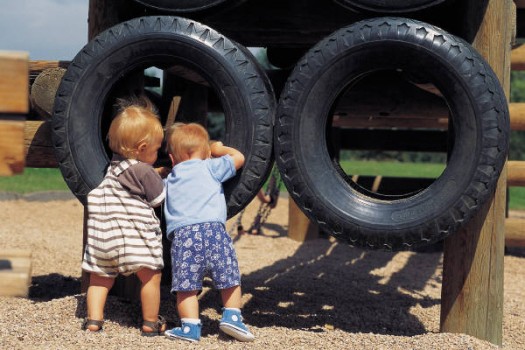
These little ones may not have a lot of speech yet, but they probably understand quite a bit of language
What is Language?
While speech involves the physical motor ability to talk, language is a symbolic, rule governed system used to convey a message. In English, the symbols can be words, either spoken or written. We also have gestural symbols, like shrugging our shoulders to indicate “I don’t know” or waving to indicate “Bye Bye” or the raising of our eye brows to indicate that we are surprised by something.
I like how ASHA, the American Speech Language Hearing Association, defines language: Language is made up of socially shared rules that include the following:
- What words mean (e.g., “star” can refer to a bright object in the night sky or a celebrity)
- How to make new words (e.g., friend, friendly, unfriendly)
- How to put words together (e.g., “Peg walked to the new store” rather than “Peg walk store new”)
- What word combinations are best in what situations (“Would you mind moving your foot?” could quickly change to “Get off my foot, please!” if the first request did not produce results)
Some of these “rule” systems that govern a language can include syntax, semantics, phonology, morphology, and pragmatics. You can more about language in my post What is Language.
Language allows us to communicate
You can have language without having speech
Though speech and language are related, you do not have to have speech to have a language. How? The best example of this is the use of Sign Language. American Sign Language, or ASL, is its own language. It is not just a gestural form of American English. It has its own set of rules to govern how it is used: Its own symbols, syntax, pragmatics, etc. For example, in spoken English, the symbol for a four legged animal that says “Meow” is “cat” however the symbol for this same thing in ASL is the sign for “cat”. You can completely communicate in ASL without ever speaking a word. This is a language that does not use speech.
What is communication?
Communication, then, is the process of conveying a message or meaning to establish a shared understanding to others. You don’t need speech or a shared language to communicate. How? Let’s say you decide on a trip to Rome, but you don’t speak one word of Italian. You get off your plane, and you want to pick up your rental car, but you can’t read any of the signs. You find a local, but he doesn’t speak English. What can you do to communicate to this person that you want to know where the rental cars are? There are a couple ways. One, you could use your hands and gestures as if you are driving a car. Another way, could be to draw a picture of a car. This could help the local Roman help you find your way to the rental cars.
So in my example above, you are communicating without using speech or a shared language (i.e. English or Italian). You are using gestures or pictures to communicate!
Communication is always the first goal
When I am working with a young child who has significant speech and language impairments, communication is the first goal. By this, I mean that sometimes a child’s ability to communicate with speech and/or language is so impaired, that we need to bypass those methods and use an alternative or augmentative communication (AAC) system to get the child communicating as soon as possible.This could be using signs, pictures, or an electronic device to give the child the ability to communicate his or her wants and needs. Then once the child is communicating, we can focus on trying to improve his/her speech skills so that he/she can use speech to communicate his/her wants and needs. I’ll be posting more about AAC and its uses in a future post.
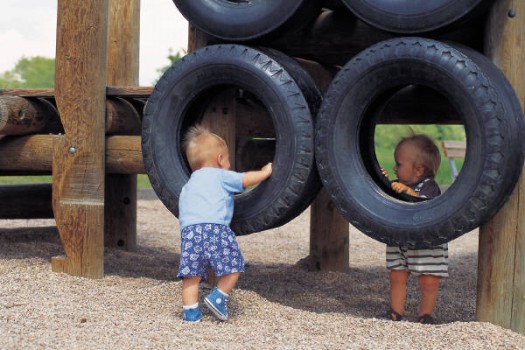
These little ones are probably communicating through gestures, facial expressions, and body language even though they aren’t using a lot of speech yet
So there you have it. Though related, speech and language are different! I hope this helps you all understand the two a little better.

Very nicely explained. 🙂
Thanks Christina! 😀
very well said.. you should be famous or something:)
Best ever explanation of the difference between the two.
Thanks a LOT dear
Very informative and lucidly put. Thank you!
Thanks a lot a well prepared comments
Thanks for this!. I”m a school student conducting research for a Home Ec project on Speech and Language Development, which accounts for 15 % of my end of year state of exams. I would be delighted if you could offer any advice etc.
Added this to my blog as an “info” link. Thanks!
Wonderful, thanks so much! 🙂
My daughter when she was two could label about 200 items, but could not for the life of her communicate. If she wanted something on the counter that she could not reach, she would throw herself on the ground and cry until I picked up the right item and it was in her hot little hand, leaving me often guessing and handing her multiple items before I gave her the correct one. No non-verbal communication either like pointing or reaching. However, once the item was in her hand, she would label it correctly, e.g., “water” or “cup.” So there was speech with no communication. Thankfully those days are over, and she is now 11 and able to share with me just have unhappy her pre-teen self is with her embarrassing mother. 🙂
Tara, yes you absolutely can have speech without communication! I am happy to hear those, I am sure frustrating, days are behind you! Thanks for your comment!
I’m from Brazil, and your texts are helping me a lot! Thank you so much for sharing your knowledge.
Hello Thanks I have started following your teachings. Ebow is my name, I am in in Accra, Ghana West of Africa. My son is turning 3 but just makes funny sounds. He tries to repeat what we say but am I not sure if he understands. However he seems to be follow able to follow instructions. He spends too much time sucking the tongue. He will most of the time rather murder what I say sucking on his tongue than say it accurately opening the lips.
keep your good work, have me in mind as you send info across cos I am learning in order to help my boy. Any personal advice is also welcome. Thank you, once again.
Hi Katie,
I am an English major and I am now learning Language Acquisition and Language Linguistics, I hope to learn more about language and and the different rules of Linguistics as language and Linguistics both go hand in hand. Your blog has helped me to understand speech and language. I found it a bit difficult to understand but you cleared it up nicely for me.
Thanks A lot!
Great article thanks for clarifying and sharing!
Hi Katie,
My son is around two and a half years old who can read and identify A to Z, 1 to 20, colors, fruits, vegetables with ease. He can even identify and name family members and other relatives.
But the problem is that he doesn’t communicate with his parents and other family members as he doesn’t utter any complete sentences apadt from a few two word sentences. Whenever he talks to us we are not able to understand as his words are not clear. His sentences sound like aa wuda me la ne daaoo.
Wat should we do.
Hi Katie,
My name is jaina. I’m mother of 2 boys 4 and 2. I’m having problems with my older one with speaking. he can understsand what I’m saying. but his answers are still in one or two words. he goes to school 3 days a week but still not fully talking. we do speak 2 languages but still he is not talking fluently in our language either. How can I help my son ta talk. Can you please help me.
Thank you,
Jaina
Hi I teach Deaf and Hard of hearing preschool aged children and i am ever so grateful to see the inclusion of ASL as a viable language in your article!
I would like to have further knowledge as a specialist educator. Thanks for directing me to accredited school to get my certificate. I’m an Army Civilian Preschool teacher speaking almost 5 languages.